This page contains a lot of information that may give someone the idea that RC sailing is difficult. It is not, and may be the best RC model to learn to operate without risking damage. This information is provided as a source for beginners to help ensure your experience with a new boat is trouble-free. Some of the information is not needed until you start sailing regularly in our club competition, since many of the modifications have to do with durability and convenience. Most of our skippers at the pond will be happy to discuss and demonstrate the ideas shown here. It is also much easier to learn by seeing. So please don't try to absorb it all in one sitting. In addition to this Getting Started page, also read Sailing is Fun and Questions and Answers on this website then examine the AMYA resources shown below.
RADIO FREQUENCY: . Radios that come with the V-32 and the Dragon Force operate on the 2.4 GHz band and do not cause interference with other radios. The the 2.4 GHz radios are sold by Specktrum, JR, and Futaba--as well as other brands. The transmitter searches the channels to find an unused frequency, then when the receiver is turned on, it searches for the transmitter's signal. In addition, the receiver will only take commands from one transmitter--and it knows which one!
75 MHz radio frequencies are authorized by the FCC for non-flying models. Each of these frequencies has an assigned "Channel Number," 61 through 90. Two boats may not operate on the same channel because they will interfere with each other and both boats will become uncontrolable. You must use a freqency/channel that is not being used by another skipper.
72 MHz (Channels 11 -60) are for model airplanes and FCC regulations state that they may NOT be used for boats, cars and other non-flying models. See authorized frequency page for a list of legal RC boat frequencies. See this site for all air and ground authorized frequencies/channels for model operation.
If you already have a 75MHz or a 2.4 GHz radio (like the ones used in RC cars), it can be used in your new boat and Victor will sell you a boat without the radio at a slightly reduced cost. At this time Dragon Force boats are not available without the radio. 2.4 GHz radios may be used on airplanes, cars, and boats.
A 2.4 GHz radio/receiver costs $50 - $200, depending on features, and almost all skippers use these.Recommend that you learn some new terms for parts of a sailboat and even for left, right, front, and back. Study the illustration below and the Definitions page at AMYA. Go to the School of Sailing Glossary to see every sailing term there is--maybe use those words to stump your sailing buddies.
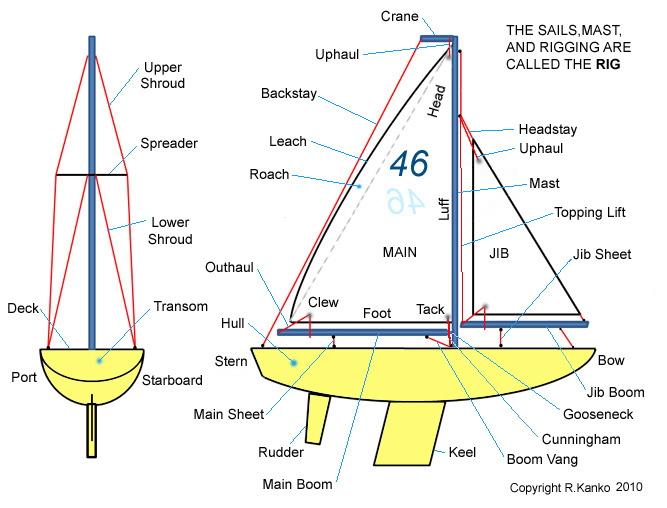
The AMYA is the national governing body for model yachting. The Kettering Model Sailing Club is AMYA registered club #237. Our charter requires all club members to be AMYA Members and have their boat registered with the Class Secretary. V-32s come with a hull number, but Dragon Force boats are assigned by the RG-65 Class Secretary.
~~~~~~~~~~~~~~~~~~~~~~~~~~~~~~~~~~~~~~~~~~~~~~~~
~~~~~~~~~~~~~~~~~~~~~~~~~~~~~~~~~~~~~~~~~~~~~~~~
Once you get familiar with RC sailing and find yourself racing, you will need to learn the Rules of Racing. Our club races according to these rules (or at least we try), so it is important to study them. Plunging into the complete Rules of Racing book before you know all the terms and have been in a race may not be the best way to begin. The first two items below are a good place to start. Initially, focus on understanding Port/Starboard and Windward/Leeward rights.
~~~~~~~~~~~~~~~~~~~~~~~~~~~~
KMSC sails two classes, the V-32 and the Dragon Force. Sources for V-32 and Dragon Force Boats are provided on Links page.
 DRAGON FORCE information: Go to the Dragon Force page. |
 V-32 information: Continue on this page. |
Please note that the V-32 class rules require that we all use a Victor Model Products V-32 to compete in this class.
If you have decided to sail V-32s with us, the first thing you will need is a boat. Factory built V-32s, complete with a good 2.4 GHz radio may be ordered direct from Victor Model Products, or from a retail distributor. Victor also sells kits (V-32k). Used V-32s can be purchased locally or from an online source such as Ebay. Check with the KMSC Commodore for used boats. Both good and bad used boats have been purchased online, so buyer beware. Most of our members sail factory built V-32s and have been very pleased with the quality of the boats. If you have some experience building plane or boat kits, and have the time, you can save approximately $250 by building your own from a kit. When you visit us at the pond, ask a few skippers about building a V-32 kit.
~~~~~~~~~~~~~~~~~~~~~~~~~~~~~~~~~~~~~~~~~~~~~~~~
BEFORE YOU PUT THE BOAT IN THE WATER: Carefully inspect the outside of the joint between the hull and the deck all the way around. Once in awhile this joint has a gap that could allow your boat to fill with water and cause it to sink. The gap could develop during shipping, handling, or maybe during gluing. Have seen this in only one boat--which was purchased from a dealer (not the factory) as closeout stock. Rebond any gaps with epoxy or super glue. Check this seam often, especially after your boat is hit by another.
A new V-32 will sail fine as-is, but the first three items should be completed as soon as possible to prevent problems, and the sail number should be applied so we know when your boat finishes first.
(1) KEEL SEAL: A few new boats have a leak around the keel box. This should be identified the first time a boat is sailed. It is very important on the first sail to bring the boat back after 5 or 10 minutes to see if it is taking on water. This leak is easily fixed by putting a substantial fillet of epoxy inside the boat at the hull-keelbox joint and also apply some epoxy to the other keelbox joints. You may prevent this problem by applying the epoxy before the first voyage.
(2) RUDDER TUBE: The tube that sticks out of the rudder is a hollow brass tube that may be crushed when the control arm screw is tightened. This makes it very difficult to remove the rudder, may also cause the screw to loosen, and may let rudder fall to the bottom of the pond. To prevent this, insert and glue a solid 1/8 brass or aluminum rod inside the tube so the tube will not be crushed when tightening the screw. Insert the solid rod as far as you can to give added strength to the rudder post. Also recommend replacing the phillips head screw with an allen head screw--the phillips head screw is not easily tightened in this awkward location. This modification is pretty important.
(3) MAST JACK: The little bolt on the bottom of the mast is used to keep the shrouds tight and the mast in its socket on the deck. Sometimes this bolt can screw itself to the shorter position and the mast will fall over
while sailing. Examine the tightness of your rigging regularly during sailing. Normally, this screw will be
loose on new boats and over time get tighter due to a little corrosion on older boats. If your mast jack is very easy to turn and it "adjusts" itself while sailing so the shrouds become loose, you may restrain it a number of different ways: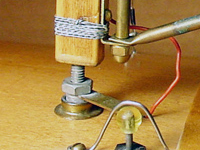
(4) SAIL NUMBERS: V-32 Class Rules require that at least the last two numbers of the hull serial number be displayed on the mainsail in contrasting colors--which usually means black. Lighter colors like orange, yellow, and light shades of other colors cannot be seen. Solid letters are the most visible. The purpose is to clearly mark your sail so the Race Director can read your number when you cross the finish line in first place.
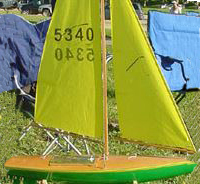
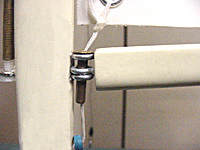
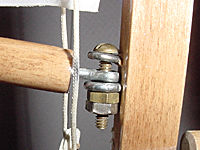
(5) GOOSENECK HINGE: The original hinge that the main boom pivots on can jam. The cotterpin on a single screw eye does not work well. The quickest fix is to install a second screw eye and put a bolt through the two screw eyes and cotter pin. See photos. You may also use a hollow rivet which makes a convenient place to thread the downhaul line through. The best fix is replacing the vang with the Victor brass assembly.
NOTE: It is normal for the leech of the mainsail to brush the backstay as the boom swings across the centerline. The leech overlaps the backstay about 3/16 of an inch and will not be a problem when tacking, even when battens are installed.
~~~~~~~~~~~~~~~~~~~~~~~~~~~~~~~~~~~~~~~~
Here are modifications often done by V-32 skippers. New boat owners should not be intimidated by this list--the mods are not critical, not required, and may be done at your leisure. Many skippers complete these items over the winter when we can't sail, but still want to play with their boats. V-32 Class Rules are pretty specific about what you can and cannot modify, and these mods are considered legal. Many of these mods are shown on the Kit Builder's Help Page.
(a) KEEL ATTACHMENT: There are two ways to attach the keel.
(b) BATTENS: Batten material should come with the boat, but battens are not installed on the sails at the factory. Batten material are the narrow strip(s) of clear plastic with self-stick. Use them to make the battens IAW the V-32 Class Rules. We can discuss and show you battens on our boats at the pond. New sails are stiff enough that battens may not be needed. However, after a few months of sailing, especially if you get caught in a rainshower, lack of battens will slow your boat because the leech will bend over.
(c) HATCH: The finger hole in the sliding, clear plastic hatch is a major source for taking on water splashed on deck in 8 to 12 mph winds. Most of us plug this hole. We can show you easy and fancy ways to do this. Best explained by looking at boats.
(d) HATCH FRAME: The wooden frame around the access hole that the clear plastic cover slides under usually has a few gaps in the glue line that allow water entry. Use epoxy to fill in all the spaces where the frame is not solidly glued to the deck. If epoxy accidentally gets on the deck or hull at an unintended spot, it can be removed with with alcohol before it cures.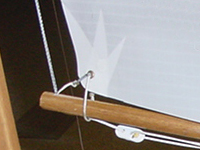
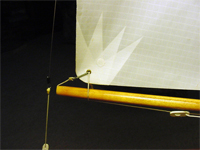
(e) CRINGLES: A cringle is the little metal reinforcment ring at the corner of a sail that is better known as "grommet" for the non-nautical types. These prevent the attachment lines from tearing the sail material. V-32 sails delivered after May 2010, have the clews (bottom aft corners of the sails) reinforced with another layer of sail material. Older sails may not come with reinforcement at the clews and the cringles may loosen and even come out. Reinforce the the clews on the main and on the jib with sail patch material and install new cringles. The
V-32 class rules specify how big the patch material can be. Again....best seen on our boats.
(f) BOOM VANG: This is the diagonal adjustment device between the mast and main boom, just below the gooseneck. Many skippers replace the original string vang with a rigid Victor Model Products vang, use their own design, or get another brand. This is permitted in our class rules. The original string vang works okay, but for precise adjustments, the metal vang with screw-adjust is easier to use. Use of the Victor metal vang also replaces the orignal eyelet-and-cotter pin gooseneck which often jams when tacking in light wind.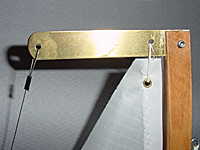
(g) CRANE: This is that little arm that extends back on the top of the mast. The crane may come loose when you catch it on a car door or when sailing in high wind conditions. If it comes loose, clean up the glue, glue it back in with epoxy and insert two small pins into holes drilled through the mast and crane. Pin the crane on a new boat before it comes loose to prevent missing a day of sailing.
(h) MAIN SHEET ANTI-FOULING: The mainsheet (line that pulls the main boom) may get tangled in the radio equipment inside the hull. Most skippers place a small clear plastic sheet above the equipment, and under the sail servo arm so when the mainsheet and jib sheets are slack, they lay on the clear plastic sheet. The clear plastic can also prevent water from falling on the receiver when it flows through the cracks between the hatch frame and hatch. Other skippers install a cross bar, strings, or rubber bands to keep the sheets free. When the sheet gets caught on equipment in the boat, it not only prevents the sail from going out to the proper setting, but can also prevent the sail control servo arm from rotating to the full in position. This causes the sail servo to draw a very high current which will quickly drain the battery and in many cases, damage the wiring, servo, and the battery. (See Photos)
BE CAREFUL: It sounds silly, but most damage to a boat occurs when it is being taken in and out of a house or car.
~~~~~~~~~~~~~~~~~~~~~~~~~~~~
The V-32 Kit Builder's Help Page has a number of V-32 photos that may be helpful for a kit builder who has never seen a completed V-32. This page was posted in response to a kit-builider who requested more detail than found in the instructions. If you are building a kit and need some other details, let me know, and more photos will be posted on that page. Go to Kit Builder's Help Page.
~~~~~~~~~~~~~~~~~~~~~~~~~~~~
If you are a V-32 skipper and have other legal modifications that improve durability or convenience, please let me know and I will post your idea with a credit to you.
Request for correction: If anyone finds items on this page to be controversial or incorrect, please contact me.
-by R. Kanko
Home | Sailing is Fun | Questions & Ans | Getting Started | Radio Frequencies| Map | Contacts| Links | Schedule | V-32 Photos
Copyright 2010, 2011, Kettering Model Sailing Club. All Rights Reserved.